Newsletter
Six stories and one chart, in your inbox by 6:30 a.m. Eastern. Written by the desk editors, not a machine.
Some of the prisoners of war that were found were born in Ukraine but consider themselves to be Russian
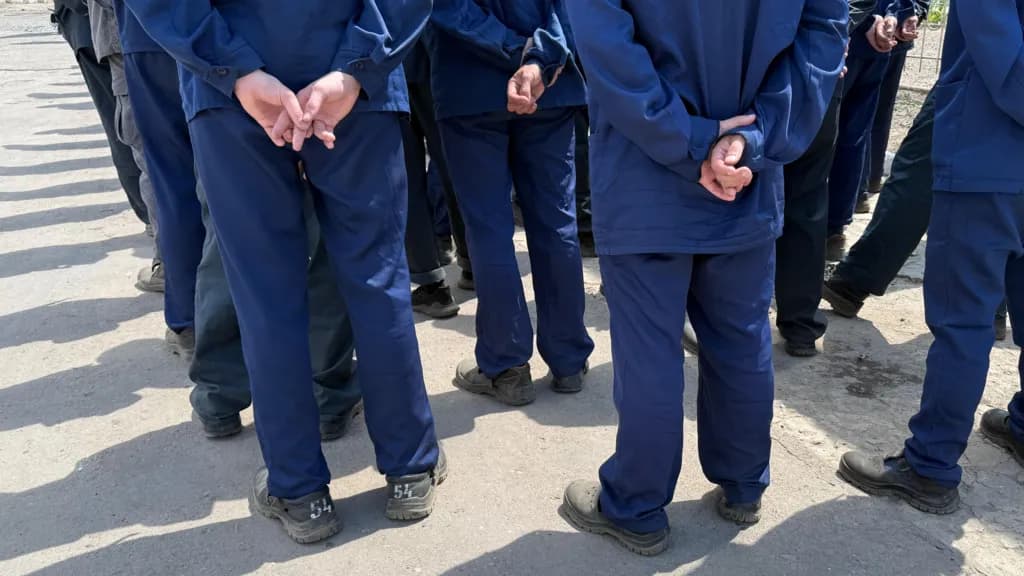
Behind locked gates in western Ukraine, a prison camp holds Russian soldiers captured during the war. But among the Russian POWs are Ukrainian-born men who chose to fight for Moscow against their own country.
Many of the Russian prisoners now being held were recruited from major cities such as St. Petersburg and Yekaterinburg. Others came from Ukraine's occupied territories, where years of Russian control have deeply influenced their views and identities.
The Meridian spoke with prisoners who agreed to interviews voluntarily, away from guards and without cameras. Their accounts offer a rare look at why some men continue fighting for Russia, even as the war takes an enormous human toll.
One prisoner, Anton, was just 10 when Russian-backed forces took control of his part of eastern Ukraine's Donbas region in 2014.
He turned 18 in 2022, shortly after Russia launched its full-scale invasion, and immediately volunteered for the Russian military.
"I don't regret my choice. I went to defend my land," Anton said.
He described receiving messages telling him that friends he had fought alongside had been killed.
Other prisoners gave similar accounts, saying many of the men they went to war with are now dead. They also claimed that fewer people are volunteering to replace them, despite large financial bonuses being offered to new recruits.
That could create another challenge for Russian President Vladimir Putin as he attempts to maintain his forces without ordering another major wave of mobilization.
Ukrainians fighting for Russia
Some of the most complicated cases involve Ukrainian citizens captured while serving in the Russian military.
Ukraine considers these men its citizens and prosecutes those who voluntarily fought for Russia for treason. However, once captured, they are generally held in POW facilities alongside Russian soldiers.
Petro Yatsenko, from Ukraine's POW coordination headquarters, described some of the Ukrainian-born fighters as having deeply blurred national identities.
"They're very pro-Russian, and their national identity is very blurred," he said.
Anton openly identifies as Russian despite being born in Ukraine.
"I consider myself Russian," he said, pointing to his family's Russian roots.
His views were heavily influenced by years living under Russian occupation, where Russian schools, media and propaganda presented Kyiv as illegitimate and portrayed Ukrainian authorities as "Nazis."
Anton now supports Putin and believes Russia should continue fighting for control of the rest of Donbas.
He acknowledges the enormous number of deaths but argues that casualties are simply part of war.
Some were willing. Others say they were forced.
Another prisoner, Artyom, was also from Donetsk. He voluntarily joined Russia's forces after spending years watching his region suffer from fighting.
But after only two months at the front, he was badly wounded by shrapnel.
Artyom said his commander treated him poorly and that he never received the 400,000-ruble enlistment payment he had been promised.


Not every Ukrainian-born prisoner made the decision willingly.
One man from Donetsk told The Meridian that Russian forces forced him into military service after the invasion. He said his family remained in the region because it was their home, not because they supported Russia.
His only goal now is to return to his wife and children.
"I'm just going to hide," he said, describing his plans if he is ever released.
Ukrainian officials have cited intelligence suggesting that more than 50,000 Ukrainians have been forcibly conscripted in occupied areas, although other estimates are significantly higher.
Convicts recruited to fight
The prison also holds Russian convicts who joined the military to escape lengthy prison sentences.
One prisoner, Konstantin, said he enlisted because he faced 15 years behind bars.
"For me, 15 years in prison was too much," he said.
Many former prisoners were promised freedom after serving in the military. But some told The Meridian that their contracts were automatically extended.
For assault troops sent into some of the most dangerous areas of the battlefield, surviving long enough to receive that freedom can be a major challenge.
Three convicted murderers told interviewers they expected to be released after a year of fighting, only to discover that their contracts had been renewed.
A war many want to end
The prison workshops provide another glimpse into the lives of the captured soldiers.
Some prisoners make wooden coffins. Others build artificial Christmas trees. Their wages can be used to purchase additional food and cigarettes.
Sergei, who was born in Luhansk, says he considers himself Russian and joined Russia's military years before the full-scale invasion.
He says he has already "done his bit" and does not want to return to the battlefield.
When asked about killing Ukrainians, he avoided answering directly.
Konstantin was more reflective.
He acknowledged that Russians and Ukrainians remain closely connected, with families and relatives on both sides.
"I see nothing good in any war," he said.
Yet despite his regret, he still believes joining the Russian military was the right decision at the time.
Neither man expects the war to end quickly. Both believe Putin will continue fighting until Russia controls the entire Donbas.
But Konstantin said something else stood out: people he knows are exhausted.
"Everyone I know there has had enough," he said. "I just want this to be over, as soon as possible."
For the Ukrainian-born soldiers inside the POW camp, the war is more than a battle between two armies. It is also a conflict over identity, loyalty and years of competing narratives.
Some chose Russia willingly. Some were driven by money or the promise of freedom. Others say they were forced.
Their stories show just how complicated the human cost of the war has become.
At lunchtime, prisoners wearing navy overalls quietly enter the dining hall, heads down and hands behind their backs.
As they eat soup and stew, a video titled Myths About Crimea plays repeatedly. The video challenges Russia's claim that Crimea historically belongs to Russia and argues that the peninsula was illegally seized from Ukraine in 2014. The prisoners barely pay attention.
The effort to change their views appears limited. For Kyiv, the main priority is exchanging the prisoners for Ukrainian soldiers held by Russia.
But for Ukrainian-born prisoners from the Donbas, there is another problem: Russia appears to have little interest in getting them back.
"Only a dozen or so have been transferred this year," Konstantin said. "It seems like they don't want to exchange us. I think we will be the last to go."
For these men, being caught between Ukraine and Russia has left them in an uncertain position, even as they wait for the war to end and hope to return home.
Additional reporting by Anastasia Levchenko
The Meridian | Independent political analysis and reporting on the stories shaping the world.